

Langton-SDL
SDL implementation of Langton’s Ant with configurable worlds and multiple ants.
A small cellular-automaton experiment originally written for MS-DOS in 1998 and ported to SDL in 2002.
Overview
Langton’s Ant is a simple deterministic discrete dynamical system. It can be viewed as a cellular automaton, a two-dimensional Turing machine or an agent system.
The world is usually represented as a square grid. Each cell has a state, and each ant moves through the grid by changing the state of the cell it visits and turning according to that state.
Langton-SDL recreates this world with SDL 1.2 and can be configured through an external langton.ini file.
Screenshots
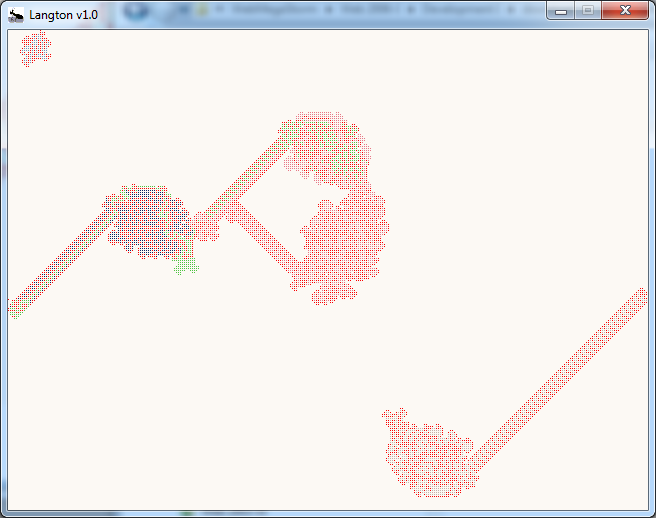
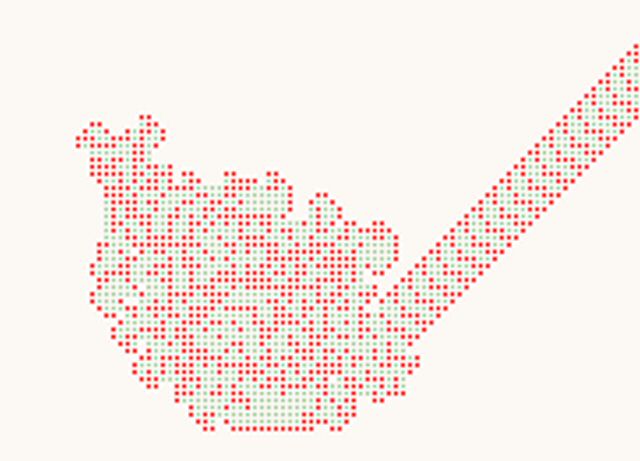
Details
Simulation 
- Custom number of ants, positions and speeds through an external
.inifile with Spanish comments. - Creates a BMP screenshot and outputs execution statistics when the run finishes.
- After enough steps, the ants tend to build the characteristic diagonal highway.
Ant Rules 
- The first movement is based on the configured initial direction.
- If the ant moves onto a non-red cell, the cell becomes red and the ant turns 90 degrees right.
- If the ant moves onto a red cell, the cell becomes non-red and the ant turns 90 degrees left.
Platform and Build 
- Windows x86 binary package is available.
- The historical code targets Linux, Mac OS X and Windows era systems.
- Linux and Mac OS X makefiles are not included.
- Developed in C++ using SDL 1.2.
Download
Latest version: v1.00 (15-June-2002)
ChangeLog | Roadmap | Free and open-source
- Binaries
- 32-bit binaries for supported operating systems.
 Windows
- Source code
- Source code and project files for VS2003+.
 Source code
- Previous releases
- Get access to all releases repository.
 Repository